
Contrails are the white lines behind high-flying planes. They are thin clouds of ice crystals that form when hot, moist engine exhaust meets very cold air at cruising altitude. Whether a trail vanishes in seconds or spreads and lingers for hours depends on how humid the surrounding air is. They are condensation trails, not sprayed chemicals.
Updated November 2026 · HappyFares
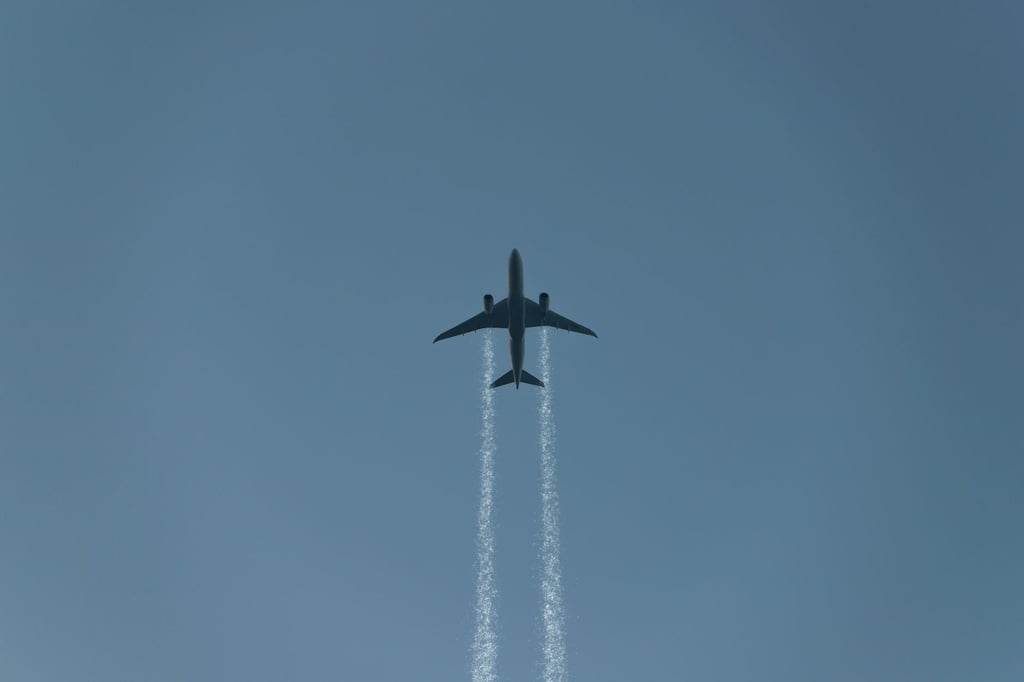
Look up on a clear day and you may see a jet drawing a bright line across the sky. Some trails disappear almost at once, while others stretch across the horizon. Here is why.
How do contrails form?
Jet engine exhaust contains water vapour. At cruising altitude the outside air is very cold, so the hot exhaust cools quickly. A National Academies report describes the threshold: a contrail forms when the cooling engine exhaust plume becomes supersaturated with respect to liquid water. In plain words, the air in the plume cannot hold all the vapour, so it condenses into tiny droplets that then freeze into ice crystals.
Tiny particles in the exhaust give the vapour something to latch on to. Whether a contrail forms depends on the temperature, pressure and humidity of the air, as well as on the engine and fuel.
Why do some contrails vanish and others last?
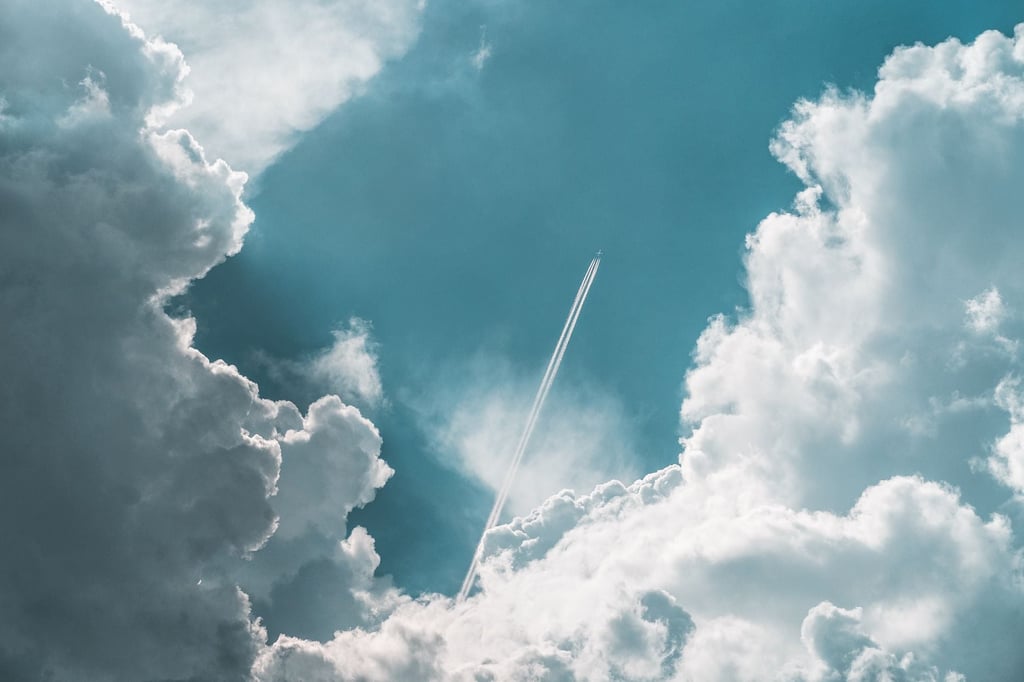
The difference is the humidity of the surrounding air. Contrails persist only as long as the surrounding air is supersaturated with respect to ice. If the air is dry, the ice crystals evaporate (sublimate) and the trail disappears within seconds or minutes. If the air is humid enough, the trail can last and even spread.
The same report says that in such humid air a persistent contrail takes up water from the surrounding atmosphere, so most of the ice in it comes from ambient moisture, not from the exhaust. It adds that persistent contrails can last from tens of minutes to hours, and that long-lived ones can spread into wide, cloud-like sheets called contrail cirrus.
The humid layers are described as horizontally vast, around hundreds of kilometres, but vertically shallow, around hundreds of metres. That is why one plane can leave a long trail while another plane just above or below leaves none.
Are contrails the same as chemtrails?
No. Chemtrails is the name of a conspiracy theory that says planes spray chemicals. Contrails are clouds of ice crystals formed from water vapour. A joint US government fact sheet from the Environmental Protection Agency, the Federal Aviation Administration and NOAA says contrails do not pose direct health risks to humans.
The exhaust does contribute a small amount of material, such as soot particles, but this is what lets the water freeze. It is not a separate substance being deliberately released.
This also explains why the sky can look different from day to day. On one day the same flight path may be crossed by planes that leave no trace at all, and on another day the sky fills with long white lines that slowly blur into a thin veil. The planes are the same; the air is not.
Scientists add that the soot particles in current engines matter for how many ice crystals a contrail contains. The National Academies report says the number of ice crystals scales with the number of soot particles emitted, and that cleaner engines and sustainable fuels may change that picture, because naturally occurring background particles could then matter more.
Do contrails matter for the climate?
Scientists do study this. Persistent contrails and the cirrus clouds they can become are of interest because they add to the atmosphere’s cloudiness. The National Academies says the net effect of contrails is most likely warming, but how strong that effect is remains uncertain, including how much extra cloud they create.
Because the persistent contrails come from a small share of flights that pass through the humid layers, research has looked at forecasting those layers and, in some trials, changing a flight’s altitude to avoid them. Forecasting where the humid regions are is a big uncertainty. This is an active research area, and there is no single fix yet.
What can you notice from your window?
A little aviation trivia: you can sometimes see a contrail form behind a wingtip during a humid takeoff or landing, caused by the pressure drop in the wingtip vortices. That is a different effect from the high-altitude trails but it is also condensation.
From the ground, short trails that fade quickly suggest dry air at that height. Long, spreading trails suggest the air up there is humid. People do use this as a rough clue, though it is not a forecast.
Common Questions
Are contrails harmful to breathe?
The joint EPA, FAA and NOAA fact sheet says contrails do not pose direct health risks to humans.
Why do some planes leave trails and others do not?
It depends on the air at the altitude the plane is flying, including its temperature and humidity, and on the engine and fuel. A plane at a different altitude can meet different air.
Do contrails form at low altitude?
Not in the usual way. Contrails need very cold air, which is typical at cruising altitudes. Near the ground the air is generally too warm for them.
How long does a contrail last?
From seconds or minutes in dry air to tens of minutes or hours in humid air.
Can contrails turn into clouds?
Yes. Long-lived ones can spread into contrail cirrus.
Does it affect my flight?
No. It does not change your flight, your fare or your schedule.
Want to see more of the sky? Search and compare flights on HappyFares, with zero convenience fee on domestic bookings, price alerts, and Meera, our AI assistant, to help you plan.
Rules and fees change; verify current specifics with the airline, DGCA, or the airport before you travel.

